


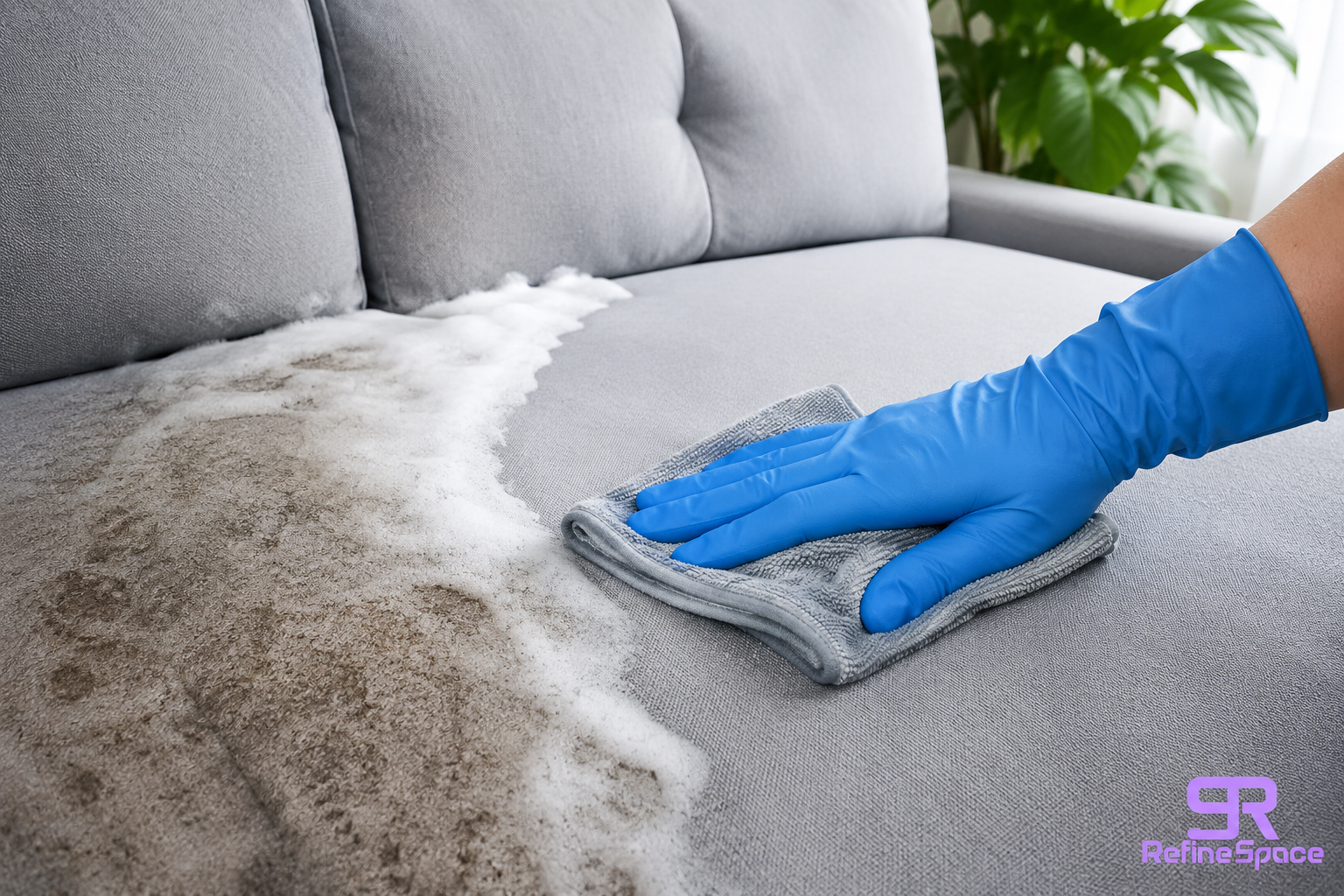
How to Clean a Sofa at Home and Keep It Looking Like Brand New
Whether you call it a sofa or a couch, how to clean a sofa at home comes down to four steps: check the care code on the tag, vacuum thoroughly, treat stains and odours using a method suited to your fabric, then let it dry completely before use. Skip the first step, and even a gentle DIY solution can leave watermarks, shrinkage, or a stain that sets in for good.
How to Clean a Sofa at Home: Quick-Answer Steps
Check the W/S/WS/X code on the tag → vacuum the entire sofa, including crevices → spot-test any cleaner on a hidden patch → treat stains with a method matched to the fabric → deodorise with baking soda if needed → air-dry fully before sitting on it again.
What Do the Care Tag Codes on Your Sofa Mean?
Before you touch a cloth or spray bottle to your sofa, find the care tag. It’s usually stitched under a cushion or along the frame’s underside, and it tells you exactly what your upholstery can handle.
Code | What It Means | Safe Cleaning Method |
W | Water-based cleaners are safe | Mild detergent, water, steam |
S | Solvent-based cleaners only | Dry-cleaning solvent, no water |
WS | Either a water- or solvent-based cleaner works | Flexible — choose either method |
X | No liquid cleaning at all | Vacuum or brush only; call a professional |
If your tag has faded or is missing altogether, treat the sofa as if it were labelled “S” and test cautiously — it’s the safer assumption for delicate or unknown fabrics.
What You'll Need Before You Start
Before you get into how to clean a sofa at home step by step, gather these basics so you’re not scrambling mid-clean. Having your supplies ready also reduces the temptation to over-wet the fabric:
- Vacuum cleaner with an upholstery attachment
- Two or three clean microfiber cloths (white, to avoid dye transfer)
- Baking soda
- Distilled white vinegar
- A small amount of mild dish soap
- A spray bottle
- Distilled water (tap water can leave mineral marks on some fabrics)
How Do You Clean a Fabric Sofa at Home?
Fabric is the most forgiving material to clean, and most fabric sofas carry a W or WS code.
- Vacuum the entire sofa first, including seams, crevices, and under cushions, to lift loose dust and pet hair.
- Test your cleaning solution on a hidden patch — the underside of a cushion works well — and wait a few minutes to check for discolouration.
- Mix a teaspoon of mild dish soap with warm water and whip it into a foam; apply only the foam, not the liquid, using a soft cloth.
- Work in small circular motions, then wipe the area with a clean, damp cloth to rinse away residue.
- Let the sofa air-dry fully, ideally with a fan or open window, before using it again.
Prefer a natural sofa cleaning solution instead? Swap the dish soap for equal parts distilled water and white vinegar, and follow the same foam-and-blot method. Using foam rather than liquid is the single biggest factor in how to clean a sofa without leaving water marks — oversaturating the fabric is what causes rings, mould, and musty smells later.
How Do You Clean a Leather Sofa at Home?
Leather needs a different approach entirely: too much water dries it out and eventually causes cracking.
- Dry-wipe the surface with a microfiber cloth to remove dust and loose debris.
- Mix a few drops of mild soap with distilled water, then wring your cloth until it’s barely damp.
- Wipe the leather in gentle circular motions, paying attention to creases and folds.
- Dry immediately with a separate, clean cloth — never let leather air-dry on its own.
- Apply a leather conditioner every three to six months to keep the surface supple and prevent cracking.
Avoid vinegar, baking soda, or steam directly on leather — these can strip its natural oils and dull the finish.
How Do You Clean a Velvet or Suede Sofa?
Velvet and suede are the most delicate common upholstery types and are usually marked S on the care tag, meaning water-based cleaning isn’t safe.
- Brush the pile in one direction with a soft-bristled brush to lift dust.
- For light marks, dab (never rub) with a cloth dampened in cool water.
- For tougher stains, work a small amount of foamed dish soap into the spot, then blot it away.
- Once dry, brush the pile again in the direction of the fibres to restore its texture.
If a stain doesn’t lift with light dabbing, stop. Aggressive scrubbing on velvet or suede often causes permanent, uneven patches that are far harder to fix than the original mark.
I have kids and honestly didn’t realize that using too much liquid was what caused those terrible watermarks on my couch. This article laid out the foam-cleaning method in a way I could actually follow at home. The W/S/X care code breakdown alone is worth bookmarking.
Sarah Jenkins
How Do You Remove Common Stains from a Sofa?
Different stains need different treatments, and reaching for the wrong one is one of the fastest ways to set a mark permanently.
Stain Type | Best Method | Quick Tip |
Coffee or tea | Dish soap foam, blotted gently | Act fast — treat before it dries |
Ink | Rubbing alcohol on a cotton swab | Work from the outer edge inward |
Grease or oil | Baking soda first, then vacuum | Let it sit 15-20 minutes to absorb |
Pet stains | Enzyme-based cleaner or vinegar solution | Neutralises odour, not just the mark |
The same blotting principle applies to rugs and carpets that share a room with your sofa. If a spill has reached both, our carpet deep cleaning guide covers fabric-safe stain removal for flooring too.
How Do You Get Rid of Bad Smells from a Sofa?
Odours usually come from trapped moisture, pet dander, or everyday use, and baking soda is the most reliable natural fix.
- Vacuum the sofa first to remove loose dirt.
- Sprinkle a generous, even layer of baking soda across the fabric.
- Leave it for at least 20 minutes — overnight for stronger smells.
- Vacuum thoroughly to remove all the powder.
Upholstered furniture is one of the main places household allergens settle, alongside carpets and bedding, according to the U.S. EPA. Regular vacuuming and deep cleaning reduce this buildup rather than eliminate it entirely, which is why odour control and allergen control usually go hand in hand.
How Often Should You Clean Your Sofa?
Frequency depends on how much use your sofa gets and who’s using it:
Household Type | Recommended Deep Clean Frequency |
Light use, no pets | Every 12 months |
Average family | Every 6-12 months |
Homes with children | Every 6 months |
Homes with pets | Every 3-6 months |
Allergy sufferers | Every 3-6 months |
Weekly vacuuming between deep cleans makes the biggest difference to how long a sofa stays fresh. It’s a five-minute habit that prevents dust from working its way deep into the fibres.
Common Sofa Cleaning Mistakes to Avoid
Following a few basic sofa cleaning tips can prevent even careful cleaning from backfiring:
- Rubbing instead of blotting — this spreads the stain and pushes it deeper into the fibres.
- Over-wetting the fabric — excess liquid causes watermarks and, in cushions, can lead to mould.
- Skipping the spot test — always test in a hidden area first, especially with coloured or unfamiliar fabrics.
- Using coloured cloths — dye can transfer onto lighter upholstery.
- Ignoring the care tag — the single most avoidable mistake, and the one most likely to cause permanent damage.
When Should You Call a Professional Sofa Cleaner?
Knowing how to clean a sofa at home covers most day-to-day situations, from light dust to fresh spills and mild odours. But some jobs call for equipment a home vacuum and spray bottle simply can’t match — deep-set stains, pet urine that’s soaked into cushion padding, persistent mould smell, or a sofa that hasn’t been properly cleaned in over a year.
This is where a professional service like RefineSpace steps in. We use hot water extraction and steam-cleaning equipment that lifts dirt and allergens from deep within the fibres, well beyond what surface cleaning reaches. Based in Al Quoz – Al Quoz 3 – Dubai – UAE, our team provides sofa deep cleaning services across the city, serving Al Quoz, Al Barsha, and surrounding areas of Dubai, including homes close to the Mall of the Emirates.
How You Can Clean Your Sofa Without Hassle
While the DIY steps above are great for minor spills and regular maintenance, deep cleaning a sofa yourself requires time, effort, and the right tools. The ultimate way to clean your sofa without hassle is to leave the heavy lifting to the experts, so you can simply sit back and relax.
Here is why homeowners across Dubai trust RefineSpace for a truly effortless experience:
- Customized Cleaning Plans: We tailor our approach to your sofa’s specific material—whether it’s delicate velvet, a leather recliner, or a heavily used fabric sectional.
- Advanced & Eco-Safe Shampoo: We pair our high-powered extraction machines with premium, eco-friendly sofa shampoos to safely wash away deep-set dirt without damaging the fabric.
- Healthier Living Space: Our complete sanitization process kills allergens, dust mites, and bacteria, making your home safer for children and pets.
- Quick Drying Time: Our low-moisture techniques ensure your sofa dries much faster—typically within a few hours.
- 100% Satisfaction Guarantee: We stand behind our work. If you aren’t completely happy with the results, we’ll re-clean it free of charge.
If your sofa needs more than a spot clean, or you’d like the rest of the home refreshed at the same time, our general deep cleaning services cover the full space. Skip the DIY hassle and let our expert team restore your furniture’s comfort and charm. You can reach us on WhatsApp or call +971 54 436 0616, or visit the RefineSpace homepage to see everything we offer and book your deep clean today!
Conclusion
Warehouse hygiene standards in Dubai aren’t a single checkbox — it’s an ongoing overlap of Municipality sanitation rules, Civil Defence housekeeping standards, and basic occupational hygiene for the people working inside the facility every day. Businesses that treat it as a documented, scheduled process rather than a once-off tidy-up are the ones that pass inspections without disruption and avoid the downtime that comes with remediation.
Whether you’re preparing for an upcoming audit or simply overdue for a proper deep clean, building hygiene into your facility’s regular maintenance calendar is the most reliable way to stay compliant year-round.
Frequently Asked Questions (FAQs)
Q1. How often should you deep clean a sofa at home?
Ans: Most households should aim for a professional deep clean every 6-12 months. Homes with pets, children, or allergy sufferers benefit from cleaning every 3-6 months instead, since these households build up dust, dander, and stains faster.
Q2. Can you clean a fabric sofa with regular detergent?
Ans: Yes, in small amounts. Mix a few drops with warm water and whip it into foam rather than applying it as a liquid — this avoids over-wetting the fabric, which can leave watermarks or take too long to dry.
Q3. How do you clean a sofa without leaving water marks?
Ans: Use foam instead of liquid, blot rather than rub, and always work from the outer edge of a stain inward. Let the sofa air-dry completely before sitting on it again.
Q4. Is vinegar safe to use on all sofa types?
Ans: No. White vinegar works well on fabric sofas with a W or WS code, but it should never be used on leather, suede, or velvet, where it can dry out or discolour the material.
Q5. How long does a sofa take to dry after cleaning?
Ans: Most fabric sofas dry within 4-6 hours using low-moisture techniques like foam cleaning. Leather dries faster since far less liquid is used, but it should still be wiped dry immediately rather than left to air-dry.
Q6. When should I hire a professional instead of doing it myself?
Ans: Call a professional for deep-set or old stains, pet urine odours, visible mould, or if the sofa hasn’t been properly cleaned in over a year. Professional extraction reaches dirt trapped deep in the cushion padding that home methods can’t fully remove.