



Warehouse Cleaning Services in Dubai: Complete Guide
Running a warehouse in Dubai comes with a challenge most facility managers in cooler climates never face: the environment itself is working against you. Between desert dust, punishing summer heat, and humidity spikes that invite mold, keeping a large industrial space spotless takes more than a broom and a mop. That’s exactly why professional warehouse cleaning services have become a non-negotiable part of running a safe, compliant, and productive facility in the UAE. This guide walks through what proper warehouse cleaning actually involves, why it matters more here than almost anywhere else, and how to choose a team that can handle it.
Key Takeaways
- Dubai’s heat, sand, and humidity accelerate dirt buildup and mold risk in warehouses far faster than in temperate climates.
- Sanitizing and disinfecting are not the same process, and warehouse managers need to know when each one applies.
- A poorly maintained warehouse raises fire risk, slip hazards, pest activity, and indoor air quality problems.
- Cleaning frequency should be broken into daily, weekly, monthly, and quarterly tasks rather than one generic schedule.
- Working with a trusted, insured cleaning company protects your inventory, your staff, and your compliance standing.
Why Warehouse Cleaning Services Matter More in Dubai's Climate
Dubai’s warehouses accumulate dirt faster than facilities almost anywhere else because of fine desert sand, intense heat, and humidity that seeps in through loading doors. These conditions combine to speed up dust buildup, corrosion, and mold growth on shelving, ducts, and stored goods. A cleaning schedule built for a mild climate simply won’t hold up here.
Fine desert sand works its way into every gap, from pallet racking to HVAC intakes, and settles on stock within days of a clean. Add in Dubai’s summer heat, which pushes warehouses to rely on AC systems almost year-round, and you get a constant cycle of dust circulating through the same air your team breathes.
Humidity swings, particularly during the cooler months, create the perfect conditions for mold and mildew wherever moisture collects near loading bays or poorly ventilated corners. Left unaddressed, this doesn’t just look bad. It can damage inventory, corrode equipment, and trigger respiratory issues among warehouse staff.
What Do Professional Warehouse Cleaning Services Include?
Warehouse cleaning services typically cover storage racks, floors, loading docks, AC ducts, employee facilities, and pest prevention, all cleaned on a schedule matched to how the space is actually used. A good provider treats each zone differently rather than running one generic clean across the whole facility.
Storage Racks, Shelving, and Pallet Areas
Storage systems collect dust and residue between inventory rotations, especially in high-traffic aisles. Cleaning should work from the top shelves down, since dust and debris naturally fall toward the floor as higher areas are cleared. This protects stock from cross-contamination and keeps racking systems in better condition for longer.
Warehouse Floor Deep Cleaning
Floors take the brunt of forklift traffic, oil drips, and tire marks throughout the day. Industrial scrubber-dryers and pressure-washing equipment lift grime that a standard mop can’t reach, which also reduces slip risk on polished concrete and resin floors. Refine Space’s floor deep cleaning services are built around exactly this kind of heavy-use environment.
Loading Docks and Vehicle Access Zones
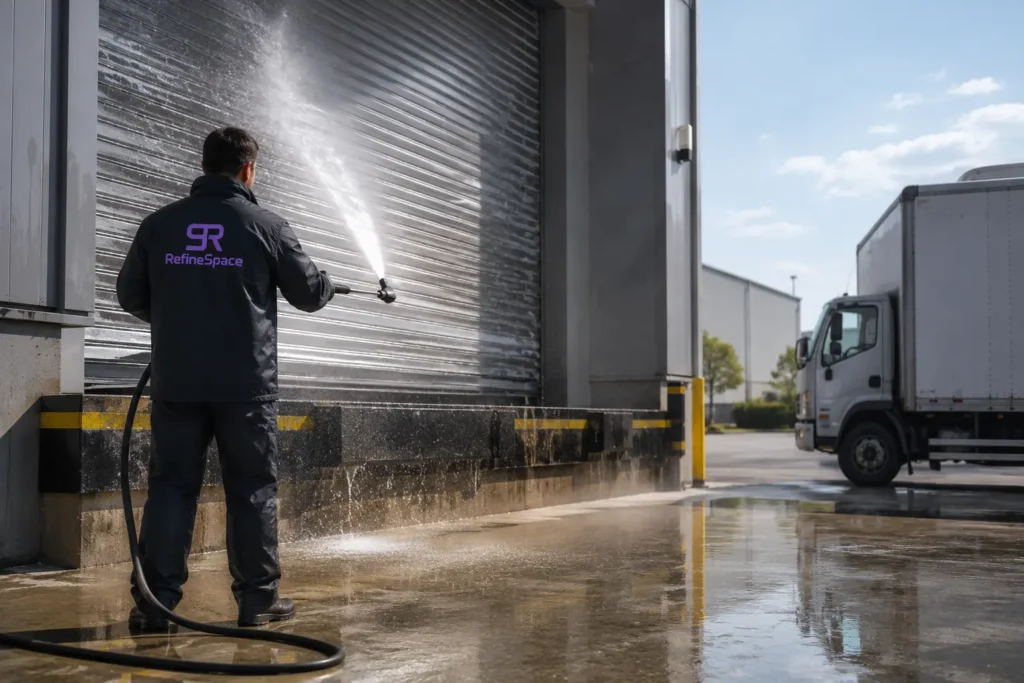
Loading bays see constant movement from trucks, forklifts, and delivery staff, which means tire marks, oil stains, and packaging debris build up fast. Power washing these zones keeps them safe underfoot and creates a better first impression for suppliers and logistics partners arriving on-site. Our power wash cleaning services are designed to handle exterior and dock-area buildup without disrupting operations.
AC Ducts and Indoor Air Quality
Warehouses that run AC continuously through Dubai’s summer months pull dust straight into the ductwork, where it recirculates through the whole facility. Routine duct cleaning protects both air quality and the lifespan of the HVAC system itself. Our AC duct deep cleaning services target exactly this buildup before it becomes a health or equipment issue.
Pest Control Integration
Food storage areas, break rooms, and dark corners near shelving are prime targets for pests once dust and food residue accumulate. Pairing routine cleaning with scheduled pest control services closes that gap before it becomes an infestation.
Building a Warehouse Cleaning Plan: Where to Start
A solid warehouse cleaning plan starts with assessing the facility’s size, floor type, and traffic patterns, then mapping every zone that needs attention before assigning tasks and timing. Skipping this step is why so many warehouses end up cleaning reactively instead of on a schedule.
Start by walking the facility and noting racking height, floor finish, aisle width, and the busiest traffic zones, since each of these affects which equipment and method will actually work. From there, list every surface and area that needs cleaning, from high shelving down to loading dock entrances, and assign who’s responsible for each.
Following a top-to-bottom order matters more than it sounds: cleaning high shelving, ducts, and light fixtures before floors means dust falls where it’s about to be cleaned anyway, not onto a surface you just finished. Keeping cleaning tools and supplies stored close to where each department actually uses them also cuts down on wasted time between tasks.
Cleaning Equipment That Gets the Job Done
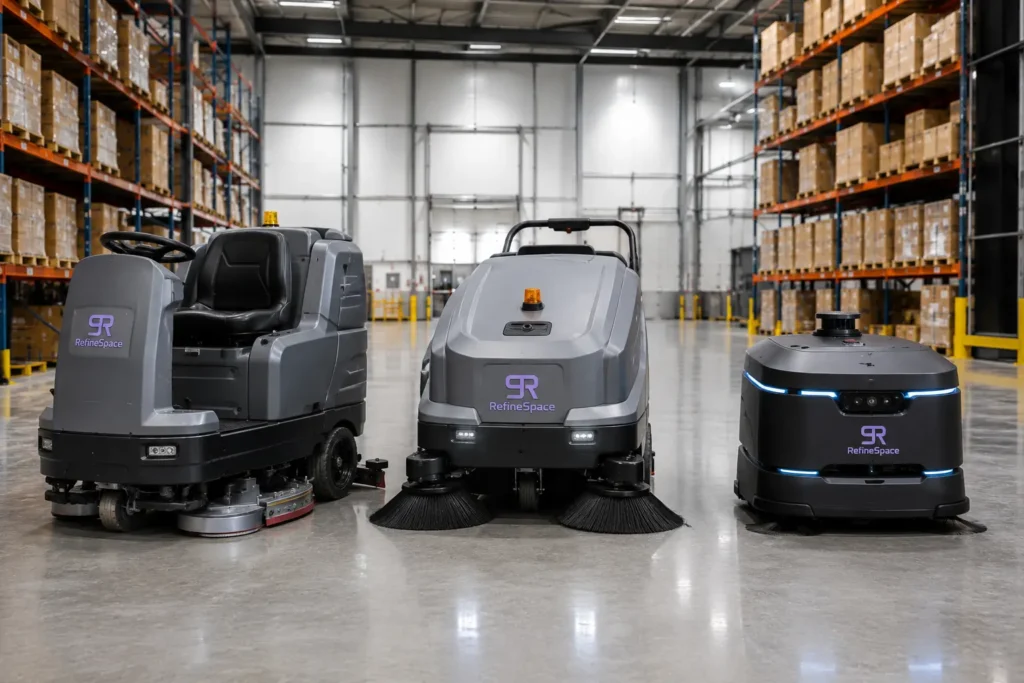
Professional warehouse cleaning relies on industrial sweepers for dust and debris, scrubber-dryers for grease and tire marks, and combination or robotic machines for large, continuously operating facilities. The right equipment depends on floor type, aisle width, and how much disruption the warehouse can tolerate during a clean.
Industrial sweepers handle the first pass, lifting loose dust and debris faster and more consistently than a broom, and without kicking fine particles back into the air. Scrubber-dryers go a step further, removing embedded grease and tire marks while drying the floor as they go, which means the area can go straight back into use without a slip hazard.
For larger sites, combination machines that sweep and scrub in a single pass cut cleaning time significantly, and battery-powered or robotic units can cover ground with minimal noise and disruption to ongoing operations. An experienced industrial cleaning team knows how to match the right machine to each zone rather than running the same equipment across the whole facility.
Sanitizing vs. Disinfecting: What Every Warehouse Manager Should Know
Sanitizing and disinfecting sound interchangeable but aren’t: sanitizing reduces bacteria to a level considered safe, while disinfecting eliminates a broader range of bacteria and viruses using products held to stricter testing standards. Knowing which one your warehouse actually needs prevents both under-cleaning and unnecessary chemical use.
Sanitizing is generally the right call for surfaces where a quick reduction in bacteria is enough, such as break room counters or general floor areas. Disinfecting is reserved for higher-risk zones like employee restrooms, food-contact surfaces, or areas following an illness outbreak among staff. The US Environmental Protection Agency notes that disinfectant products face stricter testing requirements and a higher effectiveness bar than sanitizing products, which is why the two shouldn’t be used as if they’re interchangeable.
A trained industrial cleaning team knows which product class applies to which surface, and follows label-specified contact times so the treatment actually works rather than just smelling clean.
Health and Safety Risks of a Poorly Maintained Warehouse
Warehouses that skip regular cleaning face higher fire risk, more workplace injuries, pest problems, and indoor air quality issues that can trigger asthma and allergy symptoms in staff. These aren’t hypothetical risks; they compound quietly until an inspection, an accident, or a spike in sick days forces the issue.
Dust and packaging debris are combustible in enough volume, and cluttered walkways increase the odds of trips, falls, and equipment collisions. Mold spores and accumulated dust circulating through AC systems can aggravate respiratory conditions among employees who spend eight or more hours a day on the floor. Over time, this also erodes morale, since few people want to work in a facility that feels neglected.
There’s also a compliance angle. Warehouses in the UAE are expected to meet health and safety standards set by local authorities, and a visibly dirty facility rarely passes an inspection cleanly the first time.
Really solid guide! The climate-specific challenges (sand buildup and high humidity) are so real for Dubai warehouses. Breaking down the cleaning schedule into daily, weekly, and quarterly tasks makes it super easy to follow. Thanks for putting this together!
Rizwan Ahmed
How Often Should a Dubai Warehouse Be Cleaned?
Warehouse cleaning works best when split into daily, weekly, monthly, and quarterly tasks rather than treated as one single job, since different areas get dirty at different rates. Trying to clean everything on the same schedule either wastes labor or leaves high-traffic zones neglected.
A practical breakdown looks like this:
- Daily: sweep and spot-clean floors, empty trash and recycling, wipe down high-touch surfaces like doorknobs and workstations.
- Weekly: deep-clean employee bathrooms and break rooms, wipe down forklifts and transport equipment, check for spills or leaks near stored goods.
- Monthly: inspect and sanitize floors facility-wide, dust shelving and racking systems, clean windows and light fixtures, check for early signs of mold.
- Quarterly or biannually: deep-clean AC ducts, pressure-wash loading docks and exterior areas, rotate deeper storage-facility cleaning across the full footprint.
Facilities running 24/7 or handling food, pharmaceuticals, or e-commerce fulfillment usually need a tighter schedule than a low-traffic storage warehouse.
Warehouse Cleaning After Construction, Fit-Outs, and Expansion
New racking installations, fit-outs, and facility expansions leave behind construction dust, packaging waste, and debris that a standard cleaning crew isn’t equipped to fully clear. This kind of buildup settles into ducts, shelving, and flooring before a warehouse can safely reopen to full operation. Our post-construction deep cleaning services are built specifically for this handover period, so a newly built or renovated space is ready for stock and staff without leftover residue.
Choosing a Trusted Warehouse Cleaning Company in Dubai
Look for a warehouse cleaning company that uses eco-friendly products, follows Dubai Municipality-compliant standards, and can show transparent pricing before work begins. A trusted cleaning company should also be able to explain exactly what’s included in a visit rather than leaving scope vague.
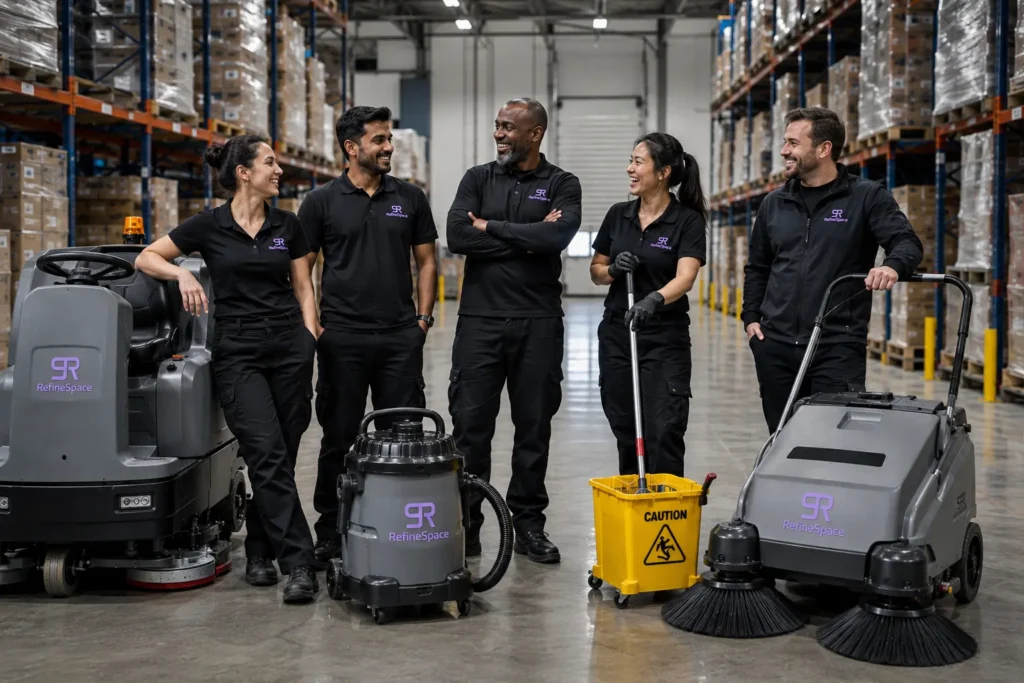
If you’re searching for a commercial cleaning near me option that also handles industrial-scale warehouse work, it’s worth checking whether the provider actually specializes in facilities this size rather than treating it as an extension of office cleaning. At Refine Space, our industrial cleaning team is trained specifically for warehouse and commercial environments, using eco-friendly, child- and pet-safe products that are still tough enough for industrial-scale grime. Every visit follows Dubai Municipality-compliant health and safety protocols, backed by a 100% satisfaction guarantee and pricing with no hidden costs. For facility-wide coverage beyond warehouses, our broader commercial deep cleaning services extend the same standard to offices and adjoining spaces.
Frequently Asked Questions
Q1. How much does warehouse cleaning cost in Dubai?
Ans: Pricing depends on warehouse size, cleaning frequency, and the scope of services needed, such as floor scrubbing, duct cleaning, or pest control. Most providers offer a free on-site assessment before quoting a transparent, fixed price.
Q2. Can warehouse cleaning be scheduled without stopping operations?
Ans: Yes. Most professional teams work around shift patterns, cleaning high-traffic zones during low-activity hours or overnight so daily operations continue without disruption.
Q3. How often should AC ducts be cleaned in a Dubai warehouse?
Ans: Given the near-constant AC use through Dubai’s summer, ducts should generally be inspected and cleaned every three to six months to protect air quality and system efficiency.
Q4. Are eco-friendly cleaning products effective for industrial warehouses?
Ans: Yes. Modern eco-friendly formulas are engineered to cut through industrial-grade grime, oil, and grime buildup while remaining safer for staff and the surrounding environment.
Q5. Does warehouse cleaning help with pest control?
Ans: Regular cleaning removes the food residue, clutter, and dust that attract pests, which makes it a strong first line of defense alongside scheduled pest control visits.
Investing in professional warehouse cleaning services isn’t just about appearances. In a city where heat, dust, and humidity work against you year-round, a properly maintained facility protects your inventory, your team’s health, and your compliance standing all at once. Choosing a trusted, experienced partner turns that from a recurring headache into a routine that runs quietly in the background.