


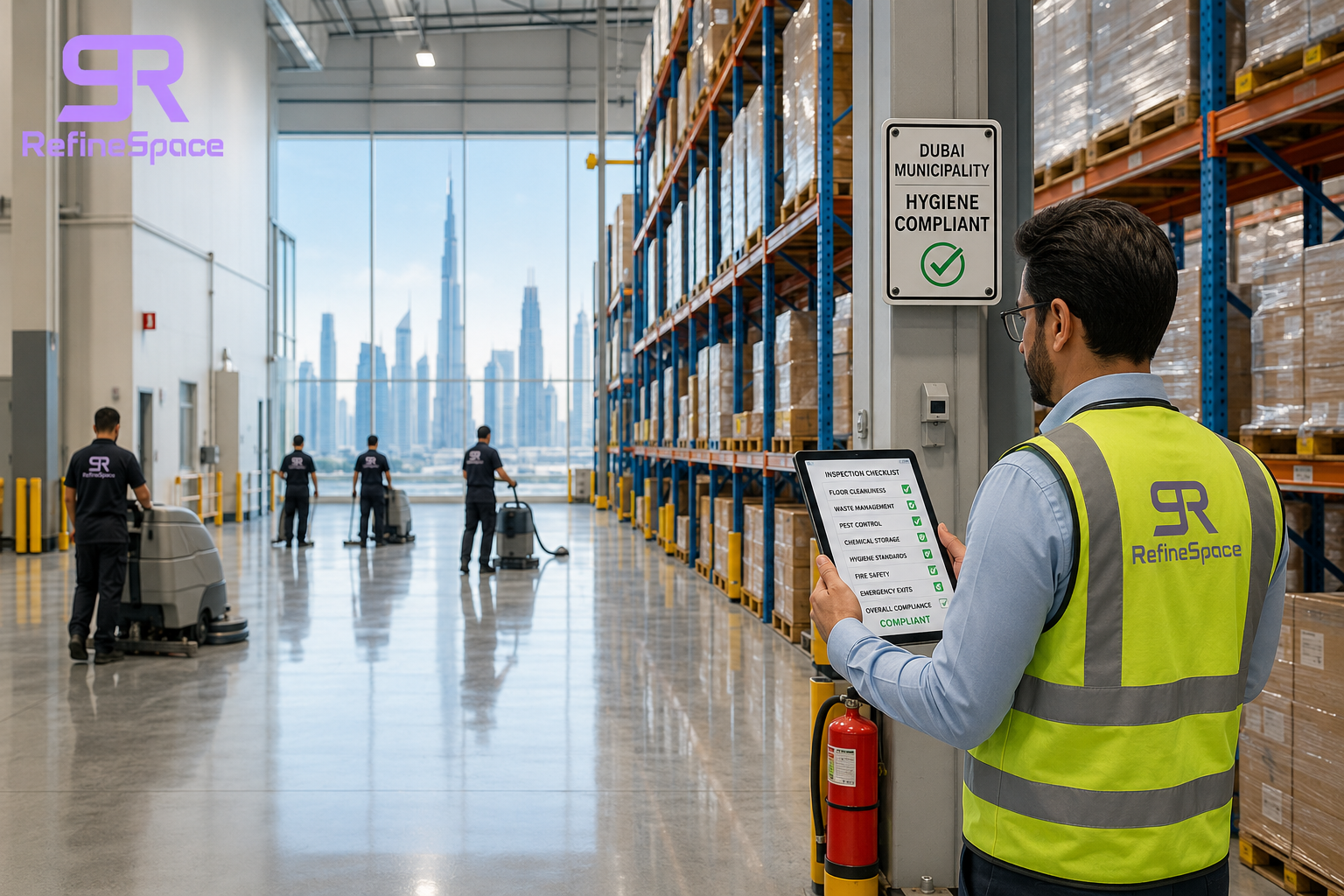
Essential Warehouse Hygiene Standards for Dubai Businesses: A 2026 Compliance Guide
Warehouse hygiene standards for Dubai businesses fall under three overlapping frameworks: Dubai Municipality’s sanitation and waste rules, Dubai Civil Defence’s fire and housekeeping requirements, and workplace hygiene obligations under UAE labor law. Meeting all three means documented cleaning schedules, proper waste segregation, pest control records, and clear, well-maintained storage areas — not just a warehouse that looks tidy on the surface.
For facility managers and business owners, this isn’t a box-ticking exercise. Warehouse hygiene compliance in Dubai touches licence renewals, insurance claims, staff wellbeing, and how a facility performs when an inspector — or a client auditing your supply chain — walks through the door unannounced.
Why Warehouse Hygiene Standards Matter for Dubai Businesses
A warehouse that fails a hygiene or safety check doesn’t just risk a fine. It risks downtime while corrective work is done, a delayed re-inspection, and in some cases a temporary halt to receiving or dispatching goods. For businesses running on tight logistics schedules, that kind of disruption is often more costly than the cleaning itself.
There’s also a quieter cost: reputational. Third-party logistics clients, insurers, and even landlords increasingly ask to see a facility’s cleaning and pest control records before signing or renewing contracts. Warehouse safety regulations in Dubai are, in practice, becoming a commercial credibility signal — not just a legal minimum.
Who Regulates Warehouse Hygiene Standards in Dubai?
Warehouse hygiene compliance in Dubai isn’t governed by a single authority. Dubai Municipality oversees general sanitation, waste management, and pest control standards, and publishes technical guidelines covering everything from food-contact materials to labor accommodation hygiene, much of which applies in principle to broader commercial and industrial premises. Dubai Civil Defence governs fire safety and housekeeping conditions that affect egress and storage layout. Meanwhile, occupational hygiene — washroom access, break facilities, ventilation — sits under UAE labor law and the Ministry of Human Resources and Emiratisation.
For most warehouses, all three frameworks apply simultaneously, which is why a genuinely compliant facility usually needs a cleaning and maintenance plan built around inspection checklists rather than ad-hoc tidying.
Core Dubai Municipality Hygiene Requirements
Municipality-aligned hygiene expectations for commercial and industrial premises generally centre on a few consistent themes:
- Documented cleaning schedules — daily, weekly, and monthly logs that can be produced on request during an inspection
- Approved cleaning products — chemicals and disinfectants carrying UAE conformity marks, used at compliant concentrations
- Waste segregation — general, recyclable, and hazardous waste kept in clearly separated streams
- Pest control records — scheduled treatments with dated, retrievable documentation
This is where storage facility cleanliness standards and industrial hygiene compliance genuinely overlap: a warehouse can look clean and still fail an audit if it can’t produce the paperwork behind that cleanliness.
Fire Safety & Housekeeping Standards That Overlap With Hygiene
Hygiene and fire safety aren’t separate conversations in a warehouse — cluttered aisles, improperly stacked pallets, and blocked emergency exits are housekeeping failures as much as safety ones. Dubai Civil Defence expects clear access routes, proper racking, and safe stacking heights, and inspectors will flag poor housekeeping alongside fire equipment checks. Keeping storage areas genuinely tidy, not just swept, supports both compliance goals at once.
Occupational Hygiene for Warehouse Staff
Workplace hygiene checklist items for warehouse staff typically include clean, accessible washrooms, hygienic break and rest areas, proper ventilation, and designated, well-maintained storage for PPE. Dubai’s summer heat adds a practical layer here too — temperatures inside poorly ventilated storage areas can approach 50°C in peak summer months, which accelerates dust buildup, pest activity, and material degradation if cleaning schedules slip. A facility that keeps staff areas genuinely hygienic tends to see fewer sick days and better retention among warehouse teams, which is as much an operational advantage as a compliance one.
Warehouse Hygiene Compliance Checklist
A practical, inspection-ready checklist for facility managers:
Daily
- Sweep and clear loading/unloading zones
- Empty and segregate waste bins
- Spot-clean staff washrooms and break areas
Weekly
- Deep-clean floors, racking, and high-touch surfaces
- Check and log pest control stations
- Inspect storage areas for blocked aisles or exits
Monthly
- Full facility deep clean, including overhead structures and hard-to-reach storage
- Review and file documented cleaning logs
- Audit chemical storage and PPE storage areas for compliance
I manage two warehouses and honestly didn't realize Civil Defence housekeeping checks and Municipality sanitation rules were basically running in parallel. This article laid out the compliance checklist in a way I could actually hand to my team. The daily/weekly/monthly breakdown alone is worth bookmarking.
Ahmed Al Mazrouei
What Happens If a Warehouse Fails a Hygiene Inspection
Non-compliance rarely means an immediate shutdown, but it does trigger a chain of costs. Missing documentation alone has led to fines starting in the low thousands of dirhams for commercial premises generally, and a failed inspection typically means a remediation period followed by a re-audit — time during which a facility may operate under restrictions. For warehouses handling client stock or bonded goods, a failed inspection can also trigger contractual penalties from the businesses relying on that storage.
How Professional Deep Cleaning Supports Compliance
Most in-house teams can manage daily tidying, but the deep, documented cleaning that inspections actually look for — degreasing floors, clearing overhead racking, treating hard-to-reach corners — is harder to sustain without dedicated resourcing. This is where a scheduled partnership with a professional cleaning provider closes the gap between “looks clean” and “passes inspection.”
RefineSpace’s commercial deep cleaning services are built around exactly this kind of documented, recurring compliance work, and for facilities needing a full reset — post-renovation, post-audit-failure, or simply overdue — our general deep cleaning services cover the same ground at a larger scale.
Why Dubai Businesses Choose RefineSpace
RefineSpace has spent years working inside Dubai’s commercial and industrial spaces, including warehouses across Al Quoz — one of the city’s largest industrial and storage districts — where facility hygiene expectations are especially high given the volume of goods moving through daily. Our teams work with documented, repeatable cleaning schedules designed to hold up under a Dubai Municipality or Civil Defence inspection, not just look presentable for a walkthrough.
We’re based at Al Quoz – Al Quoz 3 – Dubai – UAE, serving Al Quoz, Al Barsha, and surrounding areas of Dubai. You can find our full range of services on our homepage.
Conclusion
Warehouse hygiene standards in Dubai aren’t a single checkbox — it’s an ongoing overlap of Municipality sanitation rules, Civil Defence housekeeping standards, and basic occupational hygiene for the people working inside the facility every day. Businesses that treat it as a documented, scheduled process rather than a once-off tidy-up are the ones that pass inspections without disruption and avoid the downtime that comes with remediation.
Whether you’re preparing for an upcoming audit or simply overdue for a proper deep clean, building hygiene into your facility’s regular maintenance calendar is the most reliable way to stay compliant year-round.
Frequently Asked Questions (FAQs)
Q1. What hygiene standards do warehouses need to follow in Dubai?
Warehouses need to meet Dubai Municipality sanitation and waste rules, Dubai Civil Defence fire and housekeeping standards, and general occupational hygiene requirements for staff facilities and ventilation.
Q2. Who regulates warehouse hygiene — Dubai Municipality or Civil Defence?
Both, alongside labor law requirements. Dubai Municipality covers sanitation, waste, and pest control; Civil Defence covers fire safety and housekeeping that affects storage and access.
Q3. How often should a warehouse be professionally cleaned in Dubai?
Most facilities benefit from daily light cleaning, weekly deep-cleaning of high-traffic and storage zones, and a full monthly deep clean covering overhead structures and hard-to-reach areas.
Q4. What happens if a warehouse fails a hygiene inspection?
Typically a remediation period followed by a re-inspection, possible fines for missing documentation, and in some cases operational restrictions until the facility passes.
Q5. Do Dubai warehouses need documented cleaning logs?
Yes. Inspectors generally expect daily, weekly, and monthly cleaning logs to be available on request, separate from the cleaning itself being visibly done.
Q6. Can a warehouse be cleaned without disrupting daily operations?
Yes — professional teams typically schedule deep cleaning around receiving/dispatch windows or during low-activity hours to avoid interrupting logistics operations.